

July 15, 2025
Transitioning from Vocational Education and Training (VET) to university represents a significant educational milestone for onshore international students in Australia. This pathway offers expanded career prospects, enhanced academic credentials, and increased earning potential, but requires careful planning and a thorough understanding of the complex requirements. The VET-to-university pathway has become increasingly popular as students recognize the practical foundation that VET courses provide for higher-level academic study.
Understanding the VET-to-University Pathway
The Australian education system is uniquely structured to facilitate seamless transitions between different qualification levels through the Australian Qualifications Framework (AQF) . VET qualifications, ranging from Certificate I through to Advanced Diplomas (AQF levels 1-6), can provide direct pathways to university degrees (AQF levels 7-10). This structured approach enables students to build upon their existing knowledge and skills as they progress through increasingly complex academic challenges.
VET Course Levels and University Pathways:
- Certificate IV (AQF Level 4): Minimum entry requirement for higher education institutions
- Diploma (AQF Level 5): Often provides direct entry to the second year of bachelor’s degrees
- Advanced Diploma (AQF Level 6): May offer advanced standing or significant credit transfer
The pathway system is designed to recognise the practical skills and knowledge gained through VET study, allowing students to apply this experience in university contexts. Many universities have established formal articulation agreements with VET providers, creating guaranteed pathways for students who meet specific academic criteria.

Pathway Planning and Academic Preparation
Successful transition from VET to university requires strategic planning that begins well before the actual transfer occurs. Students must understand that university education differs significantly from VET training in its approach, assessment methods, and academic expectations.
Key Planning Considerations:
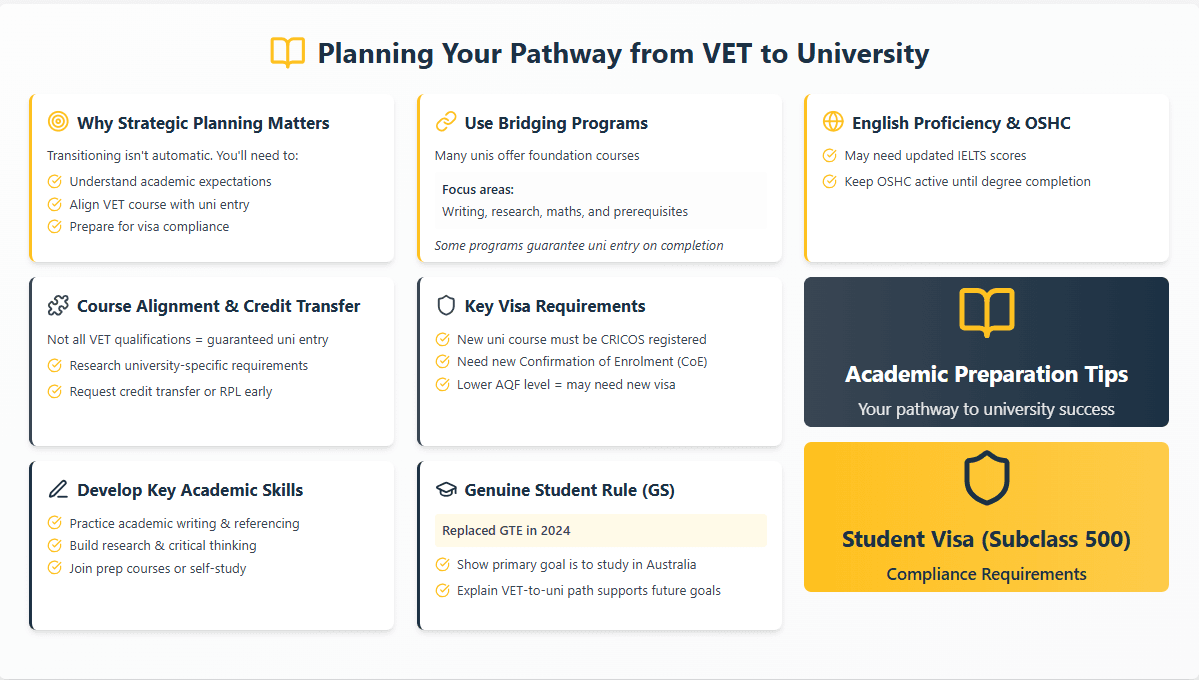
Course Alignment and Credit Recognition: Not all VET qualifications automatically guarantee university entry or credit transfer. Students must research specific university requirements and obtain written confirmation of credit arrangements before making commitments. Recognition of Prior Learning (RPL) processes vary between institutions, and students should submit credit transfer requests during their application process.
Academic Skill Development: Universities emphasize theoretical knowledge, research skills, and critical analysis, contrasting with VET’s practical, competency-based approach. Students transitioning from VET often struggle with academic writing, referencing systems, and research methodologies . Developing these skills during VET study through additional courses or self-directed learning significantly improves university success rates.
Bridging and Foundation Programs: Many institutions offer specialised programs designed to ease the VET-to-university transition. These programs typically cover academic writing, research skills, mathematics, and subject-specific prerequisites. Some universities provide guaranteed entry upon successful completion of their bridging programs.
Visa Requirements and Compliance
Transitioning from VET to university study involves complex visa considerations that must be managed carefully to maintain legal status in Australia.
Student Visa (Subclass 500) Requirements:
CRICOS Registration: The new university course must be registered with the Commonwealth Register of Institutions and Courses for Overseas Students (CRICOS). Transferring to non-CRICOS registered institutions results in visa cancellation.
AQF Level Considerations: Moving to a course at the same or higher AQF level typically does not require a new student visa. However, transferring to a lower-level qualification may necessitate a new visa application and strong justification.
Confirmation of Enrolment (CoE): Students must obtain a new CoE from their university, reflecting updated course details, start dates, and completion dates. This document is essential for visa compliance and any necessary visa extensions.
Genuine Student Requirement: As of March 2024, the Australian government replaced the Genuine Temporary Entrant (GTE) requirement with the Genuine Student (GS) requirement. Students must demonstrate that studying in Australia is their primary purpose and explain how their VET-to-university progression aligns with their educational and career goals.
English Language Proficiency: If previous English test results have expired or the university requires higher proficiency levels, students may need updated test scores such as IELTS 6.0 overall or equivalent.
Overseas Student Health Cover (OSHC): Maintaining valid health insurance throughout the entire study period is mandatory. Students must ensure their OSHC coverage extends through their university program completion.
Financial Considerations and Planning
The financial implications of transferring from VET to university are substantial and require comprehensive planning.
Updated Financial Requirements (2024-2025):
Living Expenses: International students must demonstrate access to AUD 29,710 for 12 months of living costs. This represents a significant increase from previous requirements and reflects Australia’s commitment to ensuring students can adequately support themselves.
Annual Income Alternative: Students can alternatively demonstrate that their parents or partners have a personal annual income of at least AUD 62,222 in the 12 months before application. For students with accompanying family members, this requirement increases to AUD 72,592.
Tuition Fee Increases: University tuition fees are typically higher than VET fees, requiring careful budgeting and financial planning. International students must pay fees upfront, making access to adequate funds crucial.
Visa Application Costs: The Student Visa (Subclass 500) application fee increased to AUD 1,600 in July 2024, representing a significant cost that must be factored into transfer planning.
Additional Expenses: Beyond tuition and living costs, students must budget for textbooks, equipment, practical placements, accommodation deposits, and return airfare. These costs can be substantial and are often underestimated by transitioning students.
Scholarship Opportunities: Many universities offer scholarships specifically for transfer students or those with VET backgrounds. Students should research and apply for relevant funding opportunities early in their planning process.
Success Strategies for Academic Transition
Transitioning from VET’s practical, competency-based learning to a university’s theory-driven, research-focused approach requires a strategic shift.
Academic Support Services
- University Programs: Most universities offer support like writing centres, workshops, peer mentoring, and counselling to help students adapt.
- Study Skills: Early development of time management, note-taking, critical thinking, academic writing, and research skills is crucial.
- Peer Coaching: Many universities run peer coaching programs where experienced students guide newcomers on study strategies and academic planning, especially helpful for VET transfer students.
Career Planning and Professional Development
- Career Services: Universities provide career counselling to align academic paths with long-term goals, which is especially useful for students adjusting their plans post-transfer.
- Industry Links: Stronger university-industry connections offer more internship and job opportunities—students should make use of networking events and career services.
- Post-Study Opportunities: University degrees often lead to improved post-study work rights, especially in high-demand fields.
Building Support Networks
- Peer Networks: Joining student groups and participating in campus activities helps build both academic and social support.
- Faculty Engagement: Positive relationships with lecturers and advisors can offer mentorship and academic guidance.
- International Communities: Connecting with fellow international students who’ve navigated similar transitions offers practical and emotional support.

Monitoring Progress and Compliance
Successful VET-to-university transition requires ongoing attention to both academic progress and visa compliance.
Academic Monitoring: Students must maintain satisfactory academic progress to meet visa conditions. Understanding university grading systems, assessment requirements, and progression rules is essential. Early intervention through academic support services can prevent minor issues from becoming major problems.
Visa Compliance: Regular monitoring of visa conditions, CoE validity, and OSHC coverage ensures ongoing legal status. Students should stay informed about any changes to visa conditions or requirements that may affect their studies.
Professional Guidance: Consulting with registered migration agents, university international student offices, or education counselors before making significant decisions ensures compliance with regulations and maximizes opportunities for success. This professional guidance is particularly important given the complexity of Australian immigration and education regulations.
The VET-to-university pathway offers tremendous opportunities for international students to enhance their qualifications and career prospects in Australia. Success requires careful planning, understanding of requirements, adequate financial preparation, and active engagement with support services. Students who approach this transition strategically and seek appropriate guidance position themselves for academic success and expanded career opportunities in their chosen fields.
Frequently Asked Questions
1. Can I go to university after completing a VET course in Australia?
Yes, many VET courses provide pathways to university. Depending on the qualification level, you may receive credit transfer or even direct entry into the second year of a degree.
2. Do all universities accept VET qualifications?
No. Credit transfer and entry depend on the university and course. It’s important to check entry requirements and have written confirmation of any credit arrangements.
3. What is the AQF, and how does it affect my pathway?
The Australian Qualifications Framework (AQF) ensures your VET and university qualifications align. VET is AQF Level 1–6; university begins at Level 7 and above.
4. Will I need to apply for a new student visa?
Not always. If you’re moving to a higher or same AQF level, you can usually keep your current Student Visa (Subclass 500). Lowering your AQF level may require a new visa.
5. What is the Genuine Student (GS) requirement?
Introduced in March 2024, the GS requirement replaces the GTE. You must show that your main reason for being in Australia is study, and explain how your VET-to-university plan supports your goals.